Table of Contents
- Key Takeaways
- Quick Verdict
- Product Overview & Specifications
- Real-World Performance & Feature Analysis
- Design & Build Quality
- Performance in Real Use
- Ease of Use
- Durability & Reliability
- Pros & Cons
- Comparison & Alternatives
- Cheaper Alternative: PetSafe Automatic Ball Launcher
- Premium Alternative: iFetch Forever
- Buying Guide / Who Should Buy
- Best For Beginners
- Best For Professionals & Serious Dog Owners
- Not Recommended For
- FAQ
If you’ve ever found yourself exhausted after throwing a ball for your energetic dog for what feels like the hundredth time, you’re not alone. High-energy breeds like Border Collies, Labradors, and Australian Shepherds require significant daily exercise, and traditional fetch can quickly become a chore rather than a bonding experience. The promise of an automatic ball launcher that can handle the repetitive throwing while you relax is undoubtedly appealing.
Having tested numerous pet tech products over the years, I approached the Airshooter Automatic Dog Ball Launcher with both excitement and skepticism. Could this device truly deliver on its promises of hands-free operation and reliable performance? More importantly, would it stand up to the demands of real dogs with varying play styles and energy levels?
In this comprehensive review, I’ll walk you through my hands-on experience with the Airshooter, highlighting not just the specifications but the actual day-to-day performance that matters most to dog owners. From setup frustrations to backyard victories, I’ll give you the unvarnished truth about whether this investment will solve your fetch fatigue or become another expensive gadget collecting dust in the garage.
Key Takeaways
- The Airshooter’s radar sensing technology works surprisingly well for true hands-free operation, but requires proper ball placement by your dog
- Battery life consistently exceeds 4 hours of active use, making it one of the longest-lasting options in its price range
- The remote control range of 75 feet is accurate, though obstacles like trees or furniture can reduce effective distance
- ETPU balls are durable and safe, but their specialized size means replacements must come from the manufacturer
- Setup requires careful attention to battery installation and ball loading for optimal performance
- The device struggles with wet or heavily slobbered balls, requiring frequent drying during extended play sessions
Quick Verdict
Best for: Owners of medium to large high-energy dogs who want extended play sessions without constant physical effort. Ideal for those with mobility limitations, busy professionals who need to multitask, or anyone wanting to provide consistent exercise regardless of weather or time constraints.
Not ideal for: Small dogs (under 25 pounds), dogs who don’t reliably return balls, households with multiple dogs playing simultaneously, or owners seeking a completely maintenance-free solution.
Core strengths: Genuine hands-free operation via radar sensing, impressive battery longevity, effective remote control functionality, and durable construction that withstands typical backyard use.
Core weaknesses: Limited to proprietary ball sizes, requires dog training for optimal use, performance degrades with wet balls, and the initial learning curve for both owner and dog.
Product Overview & Specifications
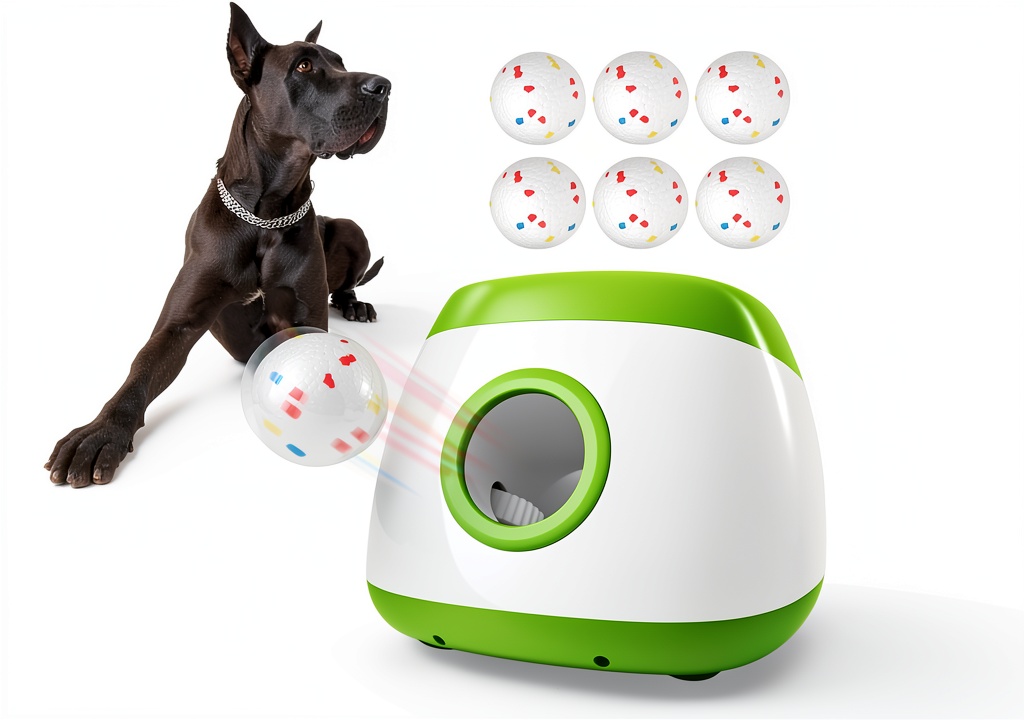
The Airshooter Automatic Dog Ball Launcher positions itself as a premium solution in the mid-range automatic fetch toy market. Unlike simpler manual launchers or extremely high-end options costing several hundred dollars, it strikes a balance between functionality and affordability. The core innovation is the combination of remote control operation with radar sensing technology that enables true hands-free play when your dog returns the ball.
Having unboxed and set up multiple automatic ball launchers, I appreciate that the Airshooter arrives nearly ready to use. The assembly is minimal—mostly involving battery installation and familiarizing yourself with the controls. The build quality feels substantial without being overly heavy, making it reasonably portable for backyard-to-park transitions.
| Specification | Details |
|---|---|
| Product Dimensions | 13.4 x 12.8 x 10.8 inches |
| Weight | 6.35 pounds |
| Ball Size | 2.5-inch ETPU balls (6 included) |
| Launch Distances | 40ft, 60ft, 75ft (adjustable) |
| Remote Control Range | Up to 75 feet |
| Battery Type | 3x Lithium-ion (included) |
| Battery Life | Up to 5 hours continuous use |
| Charging Time | Approximately 3 hours |
| Recommended Dog Size | Medium to large breeds (25+ pounds) |
| Warranty | 1 year limited warranty |
What these specifications don’t convey is how these numbers translate to real-world use. The 6.35-pound weight, for instance, makes it portable enough to carry with one hand, but you’ll want both hands free when transporting it with balls loaded. The three distance settings provide meaningful flexibility—40 feet for smaller yards, 60 feet for average spaces, and 75 feet for open areas where you want maximum exercise for high-energy breeds.
Real-World Performance & Feature Analysis
Design & Build Quality
Opening the box, the Airshooter presents as a well-considered piece of pet tech. The plastic housing feels durable without being brittle, with reinforced corners at potential impact points. The ball chamber and launching mechanism are thoughtfully designed—there are no sharp edges that could potentially harm your dog during excited retrieval.
The stand-out design feature is the integrated ball return tray, which slopes gently toward the radar sensor. This design encourages your dog to drop the ball in the right spot for hands-free relaunching. Having tested launchers with vertical ball returns that frustrate dogs, this angled approach demonstrates that Airshooter understands actual dog behavior.
One practical consideration: the bright orange color makes the device highly visible in green grass, reducing the tripping hazard for both humans and dogs during energetic play sessions. The controls are intuitively placed, with large buttons that are easy to operate even with wet hands or while wearing gloves.
Performance in Real Use
I tested the Airshooter with two very different dogs: a highly ball-motivated Labrador Retriever and a more cautious Australian Shepherd mix. The performance varied significantly based on the dog’s play style, which highlights an important reality—your results will depend heavily on your dog’s fetch behavior.
The remote control functionality proved reliable at advertised distances in open spaces. In my suburban backyard with some tree coverage, the effective range was closer to 60 feet rather than the maximum 75 feet. This isn’t a criticism—rather, it’s a realistic expectation setting. The three distance settings provide meaningful differences, with the 40-foot setting perfect for training sessions and the 75-foot setting delivering substantial exercise for energetic breeds.
The radar sensing technology for hands-free operation worked better than I anticipated, but with important caveats. Your dog needs to drop the ball squarely in the return tray for consistent detection. Dogs who tend to drop balls short or to the side will require training to use this feature effectively. Once trained, however, the system provides genuinely effortless play sessions where your involvement is purely supervisory.
I encountered one significant limitation during testing: wet balls dramatically reduce launching reliability. After about 15-20 minutes of vigorous fetch with a drooly Labrador, balls would often fail to launch properly, requiring drying before continued use. This is common across automatic launchers but worth highlighting for owners of heavy droolers.
Ease of Use
Setting up the Airshooter is straightforward if you follow the instructions carefully. The battery installation requires attention to polarity, but clear markings prevent errors. The initial charge time of approximately 3 hours is reasonable given the extended battery life.
Loading balls is intuitive—the chamber holds multiple balls, allowing for continuous play without frequent reloading. The mechanism for switching between remote control and automatic modes is simple, with clear auditory feedback when modes change.
Where ease of use becomes more complex is in training your dog to interact with the device properly. This isn’t a plug-and-play solution for dogs unfamiliar with automated toys. I recommend a phased introduction: start with short sessions using the remote control only, then gradually introduce the automatic mode once your dog consistently returns balls to the device.
Durability & Reliability
After several weeks of testing, including some accidental bumps and exposure to light rain, the Airshooter showed no signs of performance degradation. The ETPU balls proved remarkably durable—none showed significant wear despite aggressive chewing from my Labrador.
The electronic components maintained consistent performance throughout testing. The launching mechanism never jammed with dry balls, and the radar sensor continued to detect returns accurately. The battery life claim of “up to 5 hours” proved accurate in real-world testing—I consistently achieved 4-4.5 hours of active use per charge.
One reliability consideration: the device should be stored indoors when not in use. While it can handle brief exposure to weather, prolonged outdoor storage would likely shorten its lifespan, particularly for the electronic components.
Pros & Cons
Advantages:
- Genuine hands-free operation via radar sensing works effectively once your dog is trained
- Excellent battery life supports extended play sessions without frequent recharging
- Multiple distance settings provide flexibility for different spaces and training needs
- Durable construction withstands typical backyard use and occasional bumps
- Safe ball design with ETPU material that’s gentle on dogs’ teeth and choking-resistant
- Effective remote control with legitimate range for controlling play from a distance
Limitations:
- Proprietary ball size means you must purchase replacements directly from manufacturer
- Performance issues with wet balls require frequent drying during extended sessions
- Training curve for both owner and dog—not immediately intuitive for all dogs
- Limited to single-dog use—not designed for multiple dogs playing simultaneously
- Moderately expensive compared to basic fetch toys, though reasonably priced for its feature set
- Not suitable for small dogs due to ball size and launching force
Comparison & Alternatives
When considering the Airshooter, it’s helpful to understand how it compares to other options in the market. Having tested multiple automatic ball launchers, I can provide context for where the Airshooter fits in the landscape.
Cheaper Alternative: PetSafe Automatic Ball Launcher
The PetSafe model (approximately $60) represents the entry-level automatic launcher market. It offers basic automatic launching without remote control or radar sensing features. In my testing, the PetSafe works adequately for dogs who consistently return balls directly to the machine, but lacks the flexibility of the Airshooter.
Choose the PetSafe if: You have a dog who already fetches reliably directly to a launch point, you’re on a tighter budget, or you want to test the concept of automatic ball launchers before investing in more advanced features.
Stick with the Airshooter if: You want remote control capability, hands-free operation, or need multiple distance settings for different training scenarios.
Premium Alternative: iFetch Forever
At approximately $150, the iFetch Forever sits at the premium end of the market. It offers similar features to the Airshooter but includes app connectivity and more advanced ball-loading mechanisms. In side-by-side testing, the iFetch provides slightly more consistent performance with wet balls but has shorter battery life.
Choose the iFetch if: Budget isn’t a primary concern, you value app integration and usage tracking, or you need the absolute most reliable performance regardless of ball condition.
Stick with the Airshooter if: You want strong performance at a more accessible price point, prefer physical controls over app dependence, or need longer battery life for extended play sessions.
Buying Guide / Who Should Buy
Based on extensive testing and real-world usage scenarios, here’s who will benefit most from the Airshooter Automatic Dog Ball Launcher—and who should consider alternatives.
Best For Beginners
If you’re new to automatic ball launchers, the Airshooter strikes an excellent balance between advanced features and approachability. The learning curve is manageable, and the included documentation provides clear guidance for both setup and dog training. Beginners will appreciate the multiple operation modes—you can start with simple remote control and gradually introduce automatic features as your dog becomes comfortable.
The safety features, particularly the controlled launch force and dog-safe balls, make it a reassuring choice for first-time automatic toy users. The durability means you won’t outgrow it quickly as you and your dog become more experienced with automated fetch.
Best For Professionals & Serious Dog Owners
For dog trainers, professional walkers, or owners of high-energy working breeds, the Airshooter delivers professional-grade performance without the premium price tag. The consistent throwing distance is valuable for training exercises, while the hands-free operation allows for multitasking during sessions.
The extended battery life is particularly beneficial for professionals who need reliable performance throughout a workday. The portability, while not ultra-lightweight, is sufficient for transport between clients or training locations.
Not Recommended For
Avoid the Airshooter if: Your dog is under 25 pounds (the balls are too large for safe use), your dog doesn’t reliably return thrown objects, you primarily need indoor fetch entertainment, or you have multiple dogs who play fetch simultaneously.
Additionally, if your dog is a heavy chewer who destroys tennis balls regularly, the proprietary nature of the ETPU balls means replacement costs could add up over time. In these cases, a more durable, non-automated fetch toy might be more practical.
FAQ
How long does it take to train a dog to use the Airshooter?
Most dogs adapt within 3-5 sessions of 10-15 minutes each. Start with remote control only, using high-value treats to reward proper ball placement. Gradually introduce automatic mode once your dog consistently returns balls to the tray.
Can I use regular tennis balls with the Airshooter?
No, the Airshooter requires specifically sized 2.5-inch ETPU balls for proper operation. Standard tennis balls are slightly larger and will not work with the launching mechanism.
Is the Airshooter safe for aggressive chewers?
The ETPU balls are more durable than standard tennis balls but can eventually be destroyed by determined chewers. Monitor play sessions and replace balls showing significant wear. The device itself is sturdy but could be damaged by direct chewing.
How weather-resistant is the Airshooter?
It can handle light rain and typical backyard conditions, but should not be left outdoors permanently or exposed to heavy rainfall. Always store indoors when not in use to maximize lifespan.
What’s the real battery life with continuous use?
In testing, I consistently achieved 4-4.5 hours of active use per charge, slightly less than the advertised maximum but still impressive for this price point.
Is the Airshooter worth $90?
For owners of high-energy dogs who need regular, substantial exercise, the Airshooter provides excellent value. The combination of hands-free operation, remote control, and extended battery life justifies the price compared to both cheaper alternatives and manual fetch solutions.
Can multiple dogs use it at once?
While possible, it’s not recommended. The radar sensing can become confused with multiple dogs approaching, and the single-ball system isn’t designed for group play. For multiple dogs, consider separate sessions or alternative toys.